Why Therapy Isn't Healing Your Anxious Attachment
Anxious Attachment Is Not Your Flaw — It's Your Initiation
I've watched powerful men spend years in therapy learning to manage a wound that was never asking to be managed. It was asking to be integrated. If you're reading this with anxious attachment running your nervous system, your relationships, and your sense of self — I want you to hear something most of the western therapeutic model will never tell you. You are not broken. Something larger is trying to be born through you, and the insecurity you keep trying to fix is the labor pain of that birth.
What's Actually Happening When You "Get Anxious"
Let me name it plainly, because the surface story is a lie you've been told too many times.
You meet someone. You like them. You want to get closer. And the moment your heart opens, something in your body grips. The closer you move, the more you ache. The more you ache, the more you reach. And the reaching pushes away the very person you're trying to hold.
That's the pattern most people call anxious attachment. They treat it like a malfunction — a glitch in your wiring that needs fixing.
It is not a malfunction. It's a protection strategy that worked perfectly when you were small.
Somewhere early, your system learned that love could disappear. That closeness wasn't safe to trust. So your body built an alarm — a brilliant, exhausting alarm — that fires the instant intimacy gets real. The alarm isn't the problem. The alarm is doing its job.
You're not too much. You're someone whose love learned to brace for loss before it ever learned to land.
Why Therapy Keeps You Coping Instead of Healing
Here's where I'm going to be direct, because you deserve directness more than comfort.
Most western therapy was not designed to heal you. It was designed to manage your suffering. To make it quieter. More functional. Easier to live with on a Tuesday.
That's not an attack on therapists — many of them are doing sacred work inside a broken model. But the model itself treats your wound as a symptom to be regulated, not a doorway to be walked through.
So you get tools. Coping mechanisms. Breathing techniques. Cognitive reframes. And they work — a little. The suffering gets smaller. The anxiety dips. The insecurity loosens its grip just enough to function.
But it never ends. Because you were never meant to manage this. You were meant to move through it.
When my 17-year marriage ended and I began to date, I learned this in my own body. I had always been a confident, successful man. Then I'd meet a woman I actually wanted, and the anxiety would swallow me whole. The more I cared, the more I suffered. I went to therapy. I got the tools. And the tools made the suffering survivable — but they never made it stop.
Coping makes the wound livable. Integration makes the wound unnecessary.
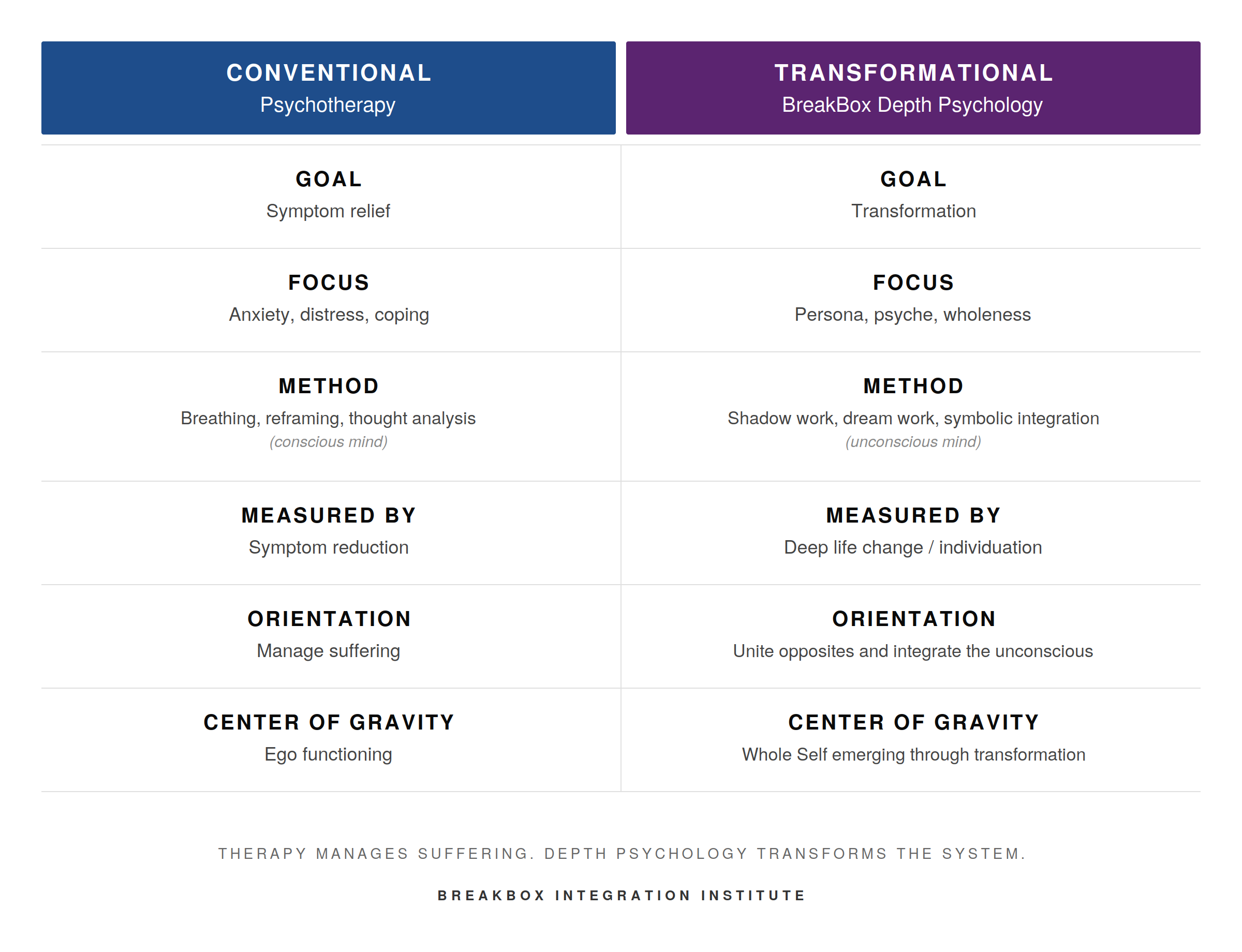
The difference isn't subtle once you see it side by side. Conventional therapy aims at symptom relief — managing anxiety and distress through breathing, reframing, and thought analysis at the level of the conscious mind. Depth psychology aims at transformation — meeting the psyche through shadow work and symbolic integration at the level of the unconscious. One manages your suffering. The other transforms the system underneath it.
The Root: What Your Body Is Actually Protecting
Go deeper with me, because this is where most conversations refuse to go.
Underneath the anxiety is an abandonment wound. And underneath the abandonment wound is something most people never reach: a part of you that went into hiding to survive, and has been waiting — for years, sometimes decades — to be welcomed home.
Carl Jung understood that what we refuse to face in ourselves doesn't disappear. It goes into shadow. It runs the show from underground. Your anxious attachment isn't random — it's the voice of an exiled part of you, the one who learned that needing love was dangerous, knocking on the door of your awareness in the only language it has.
Your nervous system isn't betraying you. It's remembering. The grip in your chest, the spiral in your mind, the desperate reach toward the person you love — that's not weakness. That's an old survival intelligence still trying to keep you safe from a threat that ended a long time ago.
The body keeps the score, yes. But the body also keeps the map. Every place you contract is pointing you toward something that wants to be reclaimed.
The wound is not the obstacle on the path. The wound is the path.
What This Is Actually Costing You
I'm not going to shame you. But I am going to tell you the truth, because productive discomfort is sometimes the most loving thing I can offer.
This pattern is costing you your leadership. The same anxiety that grips you in intimacy leaks into how you lead — the over-functioning, the need for reassurance, the inability to let people get close without managing them.
It's costing you your relationships. Not because you love too much, but because you love from a braced body, and people feel the brace even when they can't name it.
It's costing you your aliveness. Every ounce of energy spent managing the anxiety is energy not spent living, creating, leading, loving. You're running a background program that drains the foreground of your life.
And here's the deepest cost: it's keeping you from the very thing you most want. You crave deep love, real intimacy, to be fully met — and the protection strategy that was supposed to keep you safe is the exact thing standing between you and that depth.
You cannot receive a love your body is convinced will leave.
The Way Through: Integration, Not Management
This is where everything changed for me, and where it can change for you.
After all the therapy, all the tools, all the coping — I found the actual fix through what I now call BreakBox Transformational Alchemy. Not a technique to manage the anxiety. A path to integrate the wound underneath it.
The difference is everything. Management keeps the wound at arm's length and teaches you to coexist with it. Integration goes into the wound, meets the exiled part of you, and brings it home — so it no longer has to scream through your nervous system to be heard.
Here's the reframe I want to leave in your body:
Anxious attachment is not a sign that something is wrong with you. It's a sign that something bigger is trying to emerge.
The pain isn't the problem. The pain is the portal.
Let me give you a real entry point, not a teaser.
The next time the anxiety grips you, don't reach for the coping tool. Don't try to calm it down or talk yourself out of it. Instead, put your hand on the place in your body where you feel it most — usually the chest, the throat, the gut. And ask one question, out loud or in silence:
"How old is this feeling?"
Then get quiet and listen. Not with your mind — with your body. Often what answers isn't your adult self at all. It's a much younger part of you, the one who first learned love wasn't safe. That part doesn't need a technique. It needs you to turn toward it instead of away.
That turning-toward is the beginning of integration. It's the moment the exile stops being a symptom and starts becoming a son coming home.
This is what I mean by seeing what's hidden — discerning the gift beneath the wound, the power beneath the pattern. Your anxiety has been pointing at your buried fire this whole time.
What Becomes Possible on the Other Side
Let me paint you an honest picture — not toxic positivity, but earned transformation.
A man who has integrated this wound doesn't become someone who never feels. He becomes someone whose feeling no longer runs him. The anxiety that once swallowed him becomes information — a signal he can read, not a flood he drowns in.
He can get close to someone without bracing for loss. He can love fully and stay grounded in himself at the same time. His nervous system finally believes what his heart always wanted to: that he can be left and still be whole.
He leads from fullness instead of need. The over-functioning relaxes. The reaching stops. People feel safe around him because he's finally safe inside himself.
This is what widening, grounding, and embodying your fire actually looks like. Not the elimination of intensity — the integration of it. You stop shrinking your depth or escaping into your head. You bring it down into your body and let it become power.
The most attached part of you was always the most powerful part of you, waiting to be reclaimed.
Frequently Asked Questions
Why isn't therapy helping my anxious attachment?
Most western therapy is designed to manage suffering, not heal its root. It gives you coping tools that reduce the intensity of anxious attachment without resolving the underlying abandonment wound. You feel slightly better but never free, because the model treats your pattern as a symptom to regulate rather than a doorway to walk through. Real change comes from integrating the wound, not managing the symptom.
Is anxious attachment a sign something is wrong with me?
No. Anxious attachment is not a character flaw or a malfunction — it's a protection strategy your nervous system built to keep you safe when love once felt unreliable. It made perfect sense when you were young. Far from being a sign of brokenness, it's often a sign that something powerful in you is trying to emerge and be integrated.
What's the difference between coping with and healing anxious attachment?
Coping keeps the wound at a distance and teaches you to function alongside it — breathing techniques, reframes, reassurance strategies. Healing, or integration, goes into the wound itself, meets the exiled part of you that learned love wasn't safe, and brings it home. Coping makes the wound livable. Integration makes the wound unnecessary.
Can anxious attachment actually become a strength?
Yes. The intensity that drives anxious attachment is the same intensity that, once integrated, becomes depth, presence, and the capacity to love fully without bracing. The part of you that attached most desperately is often the most powerful part of you in hiding. When you reclaim it rather than suppress it, your sensitivity becomes discernment and your reaching becomes grounded, embodied leadership.
How do I start integrating my abandonment wound?
Start by turning toward the feeling instead of away from it. The next time anxiety grips you, place a hand where you feel it in your body and ask, "How old is this feeling?" Listen with your body, not your mind. This simple practice begins to meet the younger part of you that's been driving the pattern — and that turning-toward is the first step of integration, not management.
You Were Never Meant to Manage This
If you're a leader who's tired of coping with a wound that was always meant to become your power, I'd be honored to walk this path with you. Take a moment and book your assessment with me, pick a date, fill out your application, and let's find the fire underneath your anxiety together.
I with you through the transformation,

Zachary Pike Gandara
𝕻𝖊𝖗 𝖙𝖊𝖓𝖊𝖇𝖗𝖆𝖘 𝖆𝖉 𝖑𝖚𝖒𝖊𝖓 🕯️
Through darkness, into light.