Self-Mastery in Leadership: Lessons From Jensen Huang
Jensen Huang spent 33 years building Nvidia into one of the most consequential companies on earth. On November 12, 2026, he resigned as CEO and left the board, effective immediately. Not because a competitor beat him. Not because the market turned. Because of choices he made in his private life.
Self-mastery in leadership is no longer optional. It is the frontier where the most powerful careers are now being won and lost.

What Actually Happened, and Why It Matters to You
I want to be careful here, because this is a real man and a real family, and I'm not interested in gossip.
Here is what's on the public record. On November 8, Huang told Nvidia employees he had been unfaithful to his wife. That same day, the board opened an independent investigation into reports that he'd been the target of a foreign intelligence effort, involving a woman U.S. officials reportedly suspected of working for Chinese intelligence. Days later, reporting surfaced of a second affair, this one with a subordinate. Then he was gone.
The board has said it has no reason to believe national security or company secrets were compromised. The intelligence allegations have not been proven. That matters, and I'll honor it.
But sit with the shape of it. A man who helped shape the future of artificial intelligence may have put his life's work at risk through decisions made far away from the boardroom.
People keep asking why this happens to brilliant, disciplined, successful leaders. The answer is simple and uncomfortable: professional success does not equal self-mastery.
The Problem: We Train the Strategist and Ignore the Man
We teach leaders how to build companies, manage teams, read markets, raise capital, and move entire industries. We almost never teach them how to understand the unconscious patterns driving their own behavior.
So you get leaders with extraordinary intelligence, ambition, and business acumen who remain largely unaware of the parts of themselves that are hungry. Hungry for validation. For control. For pleasure, admiration, escape, or proof that they matter.
This isn't a character flaw in one famous man. It's a pattern with roots, and almost every high achiever carries some version of it.
The more power you accumulate, the bigger the consequences when those unconscious parts take the wheel.
A junior manager's blind spot costs a meeting. A CEO's blind spot can cost a company, a marriage, thousands of jobs, and in this case, a nation's trust.
Why This Happens: The Root Beneath the Behavior
Jung said that until you make the unconscious conscious, it will direct your life and you will call it fate. I've watched that play out in room after room with leaders who are sharp enough to run anything except their own inner world.
Here is what I see underneath.
Success Feeds the Parts You Never Met
Most driven leaders built their success on top of an early wound. Somewhere along the way you learned that being exceptional was how you stayed safe, loved, or seen.
That strategy works. It builds empires. But the younger part of you that needed the strategy never actually got what it was looking for. It just got louder rewards.
So the hunger doesn't go away with success. Success just gives the hunger more access. More money, more admiration, more people who won't tell you no.
The Shadow Grows in the Dark
The shadow is everything you've decided you can't be. The needy one. The lonely one. The one who wants to be adored. The one who's tired of being strong.
When you don't meet those parts with awareness, they don't disappear. They go underground and start making decisions for you, usually in the places you're least watching: your relationships, your private life, the hours after the performance ends.
The Ego Protection Cycle
In the BreakBox work, we map this as the Ego Protection Cycle: Trigger, Trauma, Protection, Judgment.
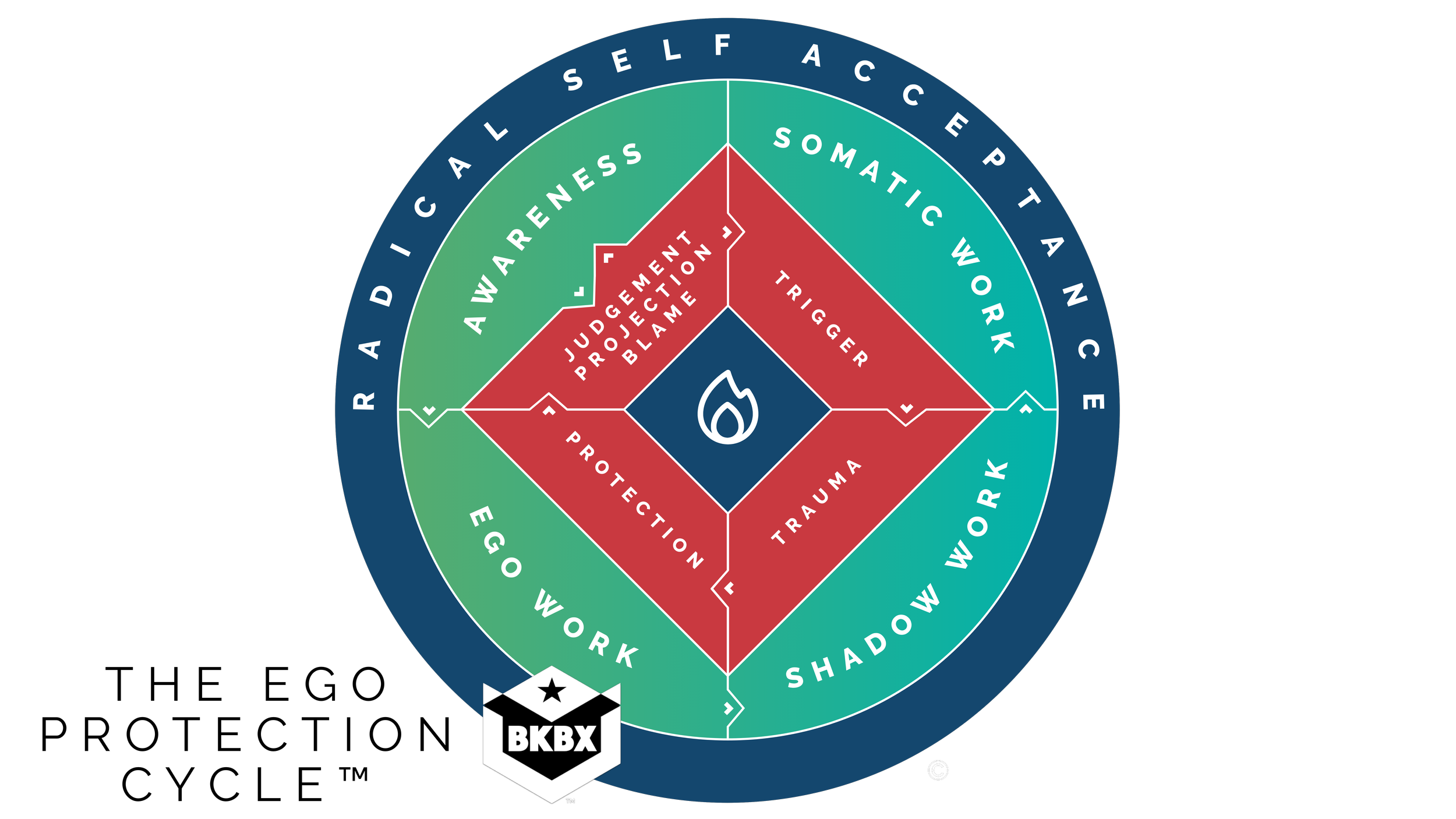
Something hits you (Trigger). It touches an old, unhealed place (Trauma). A strategy kicks in to keep you from feeling it: control, seduction, overwork, defensiveness, escape (Protection). Then comes the story you tell about yourself or others to justify it, or to punish yourself for it (Judgment).
Then it loops. And the higher you climb, the faster it spins.
A Second Lesson: Leila Hormozi and the $30 Million Meeting
Not every cost of an unintegrated pattern makes national headlines. Most of them are quieter, and they show up in how we treat ourselves.
Leila Hormozi shared a story about getting defensive in a meeting six years ago and losing a $30 million deal because of it. Afterward, she spent three straight days mentally beating herself up.
At dinner, telling her best friend what happened, the friend stopped and asked, in effect: you spent the last 72 hours sulking instead of trying to win the deal back? That landed. Leila realized every minute in that inner torture chamber was a minute not spent solving the problem. Her takeaway: "Champions don't punish themselves longer; they recover faster."
Look at that through the Ego Protection Cycle. The defensiveness in the meeting was Protection. The three days of self-attack was Judgment. Same cycle, two different faces.
Self-punishment feels like accountability, but it's often just the ego protecting itself from the deeper feeling underneath. Real responsibility is quieter, and it moves.
What It's Actually Costing You
Let's make this personal, because it isn't really about Jensen Huang or Leila Hormozi. It's about you.
An unmastered inner world costs a leader more than they usually admit:
Decisions made from compulsion that you later have to explain or clean up
Relationships where the people closest to you get your exhaustion, not your presence
A body that's always braced, wired, or numb, never fully at rest
Defensiveness that quietly kills deals, trust, and honest feedback
A private life that doesn't match the public story, and the low hum of fear that comes with that gap
And the deepest cost: you can win everything outside of you and still not be the one leading your life.
If that stings a little, good. That isn't shame. It's your own honesty knocking.
The Way Through: Self-Mastery in Leadership Starts in the Body
Self-mastery isn't about suppressing desire, controlling every emotion, or becoming a better-behaved version of yourself. That's just ego management with better branding.
Self-mastery is bringing the unconscious into consciousness, meeting the parts of yourself you've spent a lifetime avoiding, and integrating them so they stop running your life from the shadows.
Here's how that actually works.
Catch the Pattern in the Body First
Your mind will rationalize almost anything. Your body tells the truth sooner.
Before the defensive response, before the reach for the phone, the drink, the person, the next win, there's a sensation. A tightening in the chest. Heat in the face. A pull in the gut. Learning to notice that moment is the beginning of choice.
Name the Part, Don't Become It
When you feel the pull, try naming what's moving in you: "The part of me that needs to be admired is loud right now." Or, "The part of me that refuses to look weak is running this meeting."
Naming creates space. In that space, you're the one leading again, instead of the protection strategy leading you.
Recover Faster, Don't Punish Longer
When you do slip, and you will, skip the 72-hour trial. Feel what's actually underneath the failure. Grief, fear, embarrassment. Let it move through the body. Then take the next right action.
That's what integration looks like in real time: honest feeling, then clean movement.
A Practice to Start Today
Try this once a day for the next seven days. It takes about three minutes.
Sit, put both feet on the floor, and take three slow breaths into your belly.
Ask yourself: "Where in my life am I being driven instead of choosing?"
Notice where your body responds to the question. Stay with that sensation for one minute without fixing it.
Ask that place: "What are you hungry for?" Listen without judging the answer.
Write down one sentence of what you heard.
You're not trying to solve anything. You're building the muscle that powerful leaders rarely build: the capacity to be with themselves honestly.
What Becomes Possible
I've worked with leaders who came in brilliant and fractured, and I've watched what happens when they do this work for real.
They stop needing the room to validate them. They can hear hard feedback without armoring up. Their desire becomes something they hold with integrity, not something that holds them.
Their relationships deepen because the people around them finally get the whole person, not just the performance. Their decisions get cleaner and slower in the right places, and faster in the places that matter.
That's what self-mastery in leadership looks like: a man or woman who has widened and grounded their fire instead of shrinking it or being burned by it.
This is why I built BreakBox. Not to make leaders more polished. To make them whole enough to carry the power they've earned.
[IMAGE: grounded leader in calm stillness, embodied self-mastery and emotional integration]
Frequently Asked Questions
Why is self-mastery important in leadership?
Self-mastery is important in leadership because a leader's unconscious patterns scale with their power. The more influence you hold, the more people your blind spots affect. Self-mastery means understanding and integrating the emotional drives behind your decisions, so you lead from clarity rather than compulsion. Without it, even highly skilled leaders can damage the very things they built.
What is shadow work for leaders?
Shadow work for leaders is the practice of bringing hidden or rejected parts of the self into awareness. These might include needs for validation, control, pleasure, or rest that a leader has suppressed in order to perform. When those parts stay unconscious, they tend to drive behavior in private life and relationships. Integrating them gives a leader more choice, more stability, and fewer self-sabotaging decisions.
How do successful leaders sabotage themselves?
Successful leaders often sabotage themselves through unconscious protection strategies such as defensiveness, overwork, control, or seeking validation outside their primary commitments. These patterns usually formed early in life as ways to stay safe or feel worthy. Success doesn't heal them; it often gives them more room to operate. Self-sabotage tends to show up where the leader feels least watched and most entitled to relief.
Is self-mastery the same as self-control?
No. Self-control tries to suppress urges through willpower, which tends to break down under stress, fatigue, or power. Self-mastery works at the root by understanding why the urge exists and integrating the need underneath it. When the underlying need is met with awareness, the compulsion loses much of its grip. That's why self-mastery holds up in situations where pure discipline fails.
How can a leader start inner work?
A leader can start inner work by building body awareness, noticing the physical sensations that come before reactive choices. From there, naming the part of you that's driving the moment creates space to choose differently. A daily reflection practice and working with a coach trained in shadow and somatic integration can accelerate the process. The key is consistency and honesty, not perfection.
Your Next Step

BreakBox founder, Zachary Pike Gandara
If you're reading this and something in you recognized itself, don't sit on it. That recognition is the beginning of the work.
At BreakBox, I work with leaders who are done letting unconscious patterns write the story of their lives. Fill out the application and book your assessment, and let's look honestly at what's really leading you.
You've already mastered the hard things out there. Now come master the one that matters most.
— Zac

Zachary Pike Gandara
𝕻𝖊𝖗 𝖙𝖊𝖓𝖊𝖇𝖗𝖆𝖘 𝖆𝖉 𝖑𝖚𝖒𝖊𝖓 🕯️
Through darkness, into light.