Twin Flame Relationships: The Mirror That Breaks You Open
The twin flame relationship you're clinging to was never meant to complete you. It was meant to crack you open — to drag every unresolved wound, every outsourced need, every abandoned piece of yourself into the light so you could no longer avoid what's been running your life. That's not romance. That's an initiation. And if you're reading this, there's a good chance you're standing in the middle of one right now, wondering why everything that used to work has stopped working.
I know. Because I've been exactly where you are.
The Pattern You Can't Outperform
You've done well in the world. You've built things. Led people. Made decisions that shaped outcomes. But there's a place in your life where none of that competence translates — and it's the place that matters most.
Your relationships keep cycling through the same arc. Connection, intensity, fear, overreach, collapse. You've tried being more communicative. More present. More generous. And still, the same pattern returns wearing a different face.
Here's what I need you to hear: this isn't a character flaw. It's a wound with roots.
The twin flame dynamic — that all-consuming, disorienting, undeniable pull toward another person — isn't what most people think it is. It's not your soul recognizing its other half. It's your nervous system recognizing an unresolved wound and handing you an invitation you didn't ask for.
The question is whether you'll accept it — or keep running from it.
Why Twin Flame Relationships Destroy Your Defenses
Most people enter a twin flame relationship believing they've found the answer. The connection feels fated. The synchronicities stack. The recognition is immediate and overwhelming. And for a while, it feels like everything you've ever wanted.
Then it starts to unravel.
Not because something went wrong. But because the relationship is doing exactly what it came to do — it's reflecting back every part of yourself you've been refusing to face.
At BreakBox, I teach that beneath every attachment pattern are four core wounds: Abandonment, Abuse, Neglect, and Loss. A twin flame relationship has an uncanny ability to find yours with surgical precision. It doesn't matter how much therapy you've done, how many books you've read, or how evolved you think you are. This relationship will find the gap between your awareness and your embodiment — and it will live in that gap until you close it.
The reason your usual strategies fail is because they were built on top of the wound, not through it. You learned to over-give so you wouldn't be abandoned. You learned to perform so you'd be chosen. You learned to manage other people's emotions so you could regulate your own.
Those aren't connection strategies. They're survival strategies. And a twin flame will make every one of them useless.
What Anxious Attachment Is Really Doing to Your Life
Let me be direct about what this costs you — because you've probably been minimizing it.
Anxious attachment isn't just a relationship problem. It's a leadership problem. It's the reason you can run a company but can't sit still in your own living room. It's the reason you make clear decisions in a boardroom but spiral when someone doesn't text you back. It's the reason you have people who admire you and almost no one who actually knows you.
When your nervous system is wired for anxious attachment, uncertainty becomes a threat. Space becomes danger. And silence becomes a story your mind writes — always about rejection, always about loss.
Here's what it actually looks like in real life:
You check your phone with a tightness in your chest that has nothing to do with the message
You rehearse conversations to prevent outcomes you can't control
You abandon your own needs to maintain connection — and resent the person for not noticing
You confuse intensity with intimacy, and chaos with chemistry
You perform a version of yourself you think is lovable instead of showing up as who you actually are
This isn't weakness. It's a nervous system that learned early that love required vigilance. And until you address it at the root — in the body, not just the mind — it will continue to run every relationship you enter.
The Root Nobody Wants to Touch
Here's where I lose people who want a quick fix. Because the root of anxious attachment isn't in your current relationship. It isn't even in the twin flame dynamic. It's in the original wound — the one that taught your nervous system that love is conditional and presence is dangerous.
For most of the leaders I work with, this goes back to childhood. Not necessarily to trauma in the dramatic sense. Sometimes it's subtler than that. A parent who was physically present but emotionally unavailable. A household where your worth was tied to your output. A moment — or a thousand moments — where you learned that being yourself wasn't enough to guarantee belonging.
Your psyche adapted. It built an ego structure designed to prevent that wound from ever being felt again. Jung called this the persona — the mask you show the world so the world won't reject what's underneath.
The problem is, you've been wearing the mask so long you forgot it was a mask.
And the twin flame? They rip it off. Not gently. Not on your timeline. They rip it off by being the one person your usual performance doesn't work on.
That's why it feels like death. Because in a very real psychological sense, it is death — the death of a false self you've been investing in for decades.
The Way Through: Integration, Not Escape
I'm not going to tell you to "just love yourself" or "let go and trust the universe." That kind of advice is what keeps people stuck — it sounds true but it lives nowhere in the body.
The path from anxious attachment to secure attachment isn't cognitive. It's somatic. It happens in your nervous system, not your journal.
Here's what that actually looks like.
When I met Delia, I had just come out of a four-year relationship. Before that, a seventeen-year marriage. I hadn't been alone — truly alone — since I was a teenager. I was in serial monogamy, and I didn't know it, but I was using every relationship as an external regulator. Someone to soothe the ache I couldn't sit with myself.
Delia felt like destiny. But that relationship didn't stabilize — no matter what I did. Every strategy that had worked before failed. Over-giving pushed her away. Seeking reassurance created distance. Abandoning myself to keep the peace destroyed the peace.
When it ended, I didn't just grieve. I collapsed. My entire identity — built around being chosen — dissolved.
And that collapse was the beginning of everything.
I stayed alone. Not because I was strong. Because I was finally out of options. I sat with the abandonment wound I'd been running from for forty years. I learned to regulate my own nervous system. I stopped outsourcing my safety to another person's presence.
I went through a three-month Jungian intensive. I worked with a psychic coach who helped me finally meet my inner child. I studied Jung's shadow work, practiced breathwork and meditation, and learned somatic regulation — the body holds what the mind can't process.
That's when I discovered the Ego Protection Cycle — the framework that therapy couldn't give me. The map from anxious attachment to secure attachment that lives in the body, not the intellect.
A Practice You Can Start With Right Now
The next time you feel that pull — the urge to reach out, to fix, to seek reassurance — pause. Don't act on it. Instead, put your hand on your chest. Take three slow breaths. And ask yourself one question:
"Am I reaching for connection — or am I running from a feeling?"
If the answer is running, stay. Stay with the feeling. Let your body have the experience your mind has been preventing. You don't need to solve it. You need to be with it. That's where integration begins.
What Becomes Possible When You Stop Running
I want to paint this honestly, because I don't believe in selling transformation as a destination. It's not. It's a way of being.
But I'll tell you what shifted for me — and what I've watched shift in the men and women I coach.
When you stop outsourcing your worth, something quiet and powerful returns. Creativity without force. Forward motion without anxiety. The ability to be in connection without losing yourself in it.
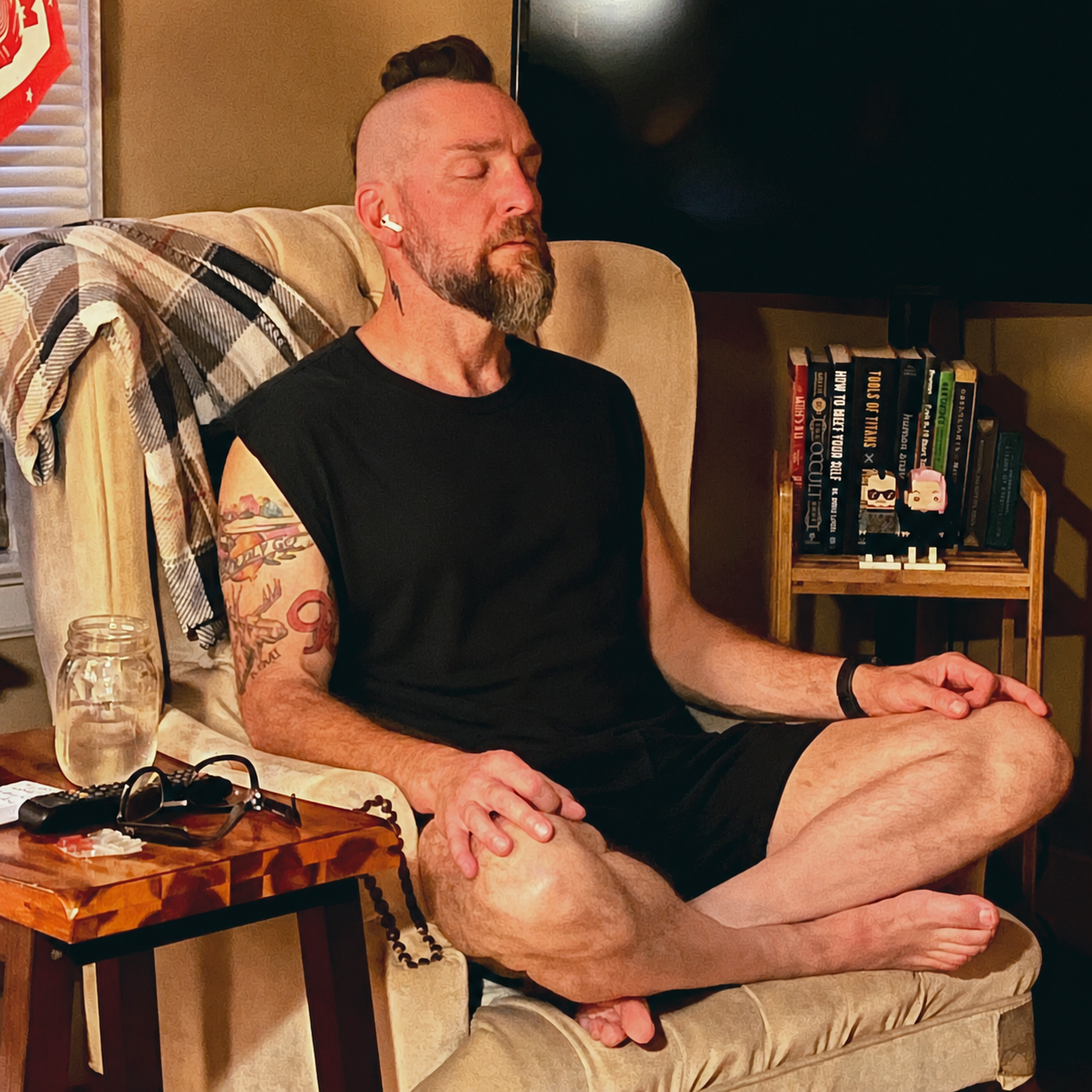
This photo was taken by my twin flame in a quiet moment I didn’t even realize was becoming something more. In this moment, I wasn’t mastering meditation. I was confronting the noise underneath everything. The tension. The stories. The patterns that had been running my life unconsciously.
This is what it looked like coming home to clarity. I was learning integration. I was learning how to stay.
Just a man sitting in a chair… learning how to come back to himself.
One of my clients came to me exhausted — not from life, but from the effort of managing his own nervous system through other people. He could name his patterns. He could communicate beautifully. But his body was still running the same anxious loop: connection, fear, overreach, collapse.
We didn't start with his relationship. We started with his body. We taught his nervous system that he could feel activation without acting on it. That he could experience uncertainty without collapsing. That he could be with himself without abandoning himself.
One night during meditation, something opened. He saw his mother — not as a memory, but as a presence. Then younger versions of himself appeared. Then his father. Calm. Still. And in the distance, his ex — no longer the center of his emotional world. Just... there.
He wasn't looking for love anymore. He was experiencing it. From within.
That's secure attachment. Not a behavior you perform. A state you inhabit.
The deepest pain often holds the deepest gift — not because pain is noble, but because it forces you to face what you've been avoiding. And on the other side of that confrontation, when you stop running and start integrating, you discover the life you were always meant to live.
He became self-led. Grounded. Present. Not perfect — but no longer at the mercy of his own activation. He stopped asking, "Do they want me?" and started living from, "I am here. I am not leaving myself."
That's what becomes possible. Not a life without pain. A life where pain no longer owns you.
Frequently Asked Questions
What is a twin flame relationship for?
A twin flame relationship exists to reveal your deepest unresolved wounds — not to complete you. It mirrors back the parts of yourself you've been avoiding: abandonment patterns, attachment wounds, and the ways you outsource your worth to others. The purpose is to break down your false self so you can integrate the shadow and build a life from your authentic center. It's not about finding your other half. It's about becoming whole.
Can anxious attachment become secure attachment?
Yes — but not through willpower or finding the right partner. Anxious attachment shifts to secure attachment through somatic work, nervous system regulation, and integration of the core wounds beneath the pattern. This means learning to feel the discomfort in your body without reacting, building internal safety instead of seeking it externally, and addressing the developmental wounding that created the pattern in the first place. It's a process that happens in the body, not just the mind.
Why do twin flame relationships feel so intense and painful?
The intensity comes from recognition — your nervous system recognizes the wound, not just the person. Twin flame dynamics activate your deepest attachment patterns because the other person mirrors the exact emotional terrain you've been avoiding. The pain isn't a sign that something is wrong. It's a sign that your ego's protective strategies are failing, which is exactly what needs to happen for real transformation to begin.
How do I know if I'm in a twin flame relationship or just a toxic one?
The distinction isn't in the other person's behavior — it's in what the relationship reveals about you. A twin flame relationship exposes your core wound and invites you into integration. A toxic relationship keeps you locked in a cycle without growth. The real question is: are you using the pain as a catalyst for self-mastery, or are you staying because the chaos feels familiar? If the relationship is showing you your patterns and you're willing to face them — that's the invitation. If you're just surviving the cycle — it's time to step back and do the inner work.
What does self-mastery look like after healing anxious attachment?
Self-mastery after healing anxious attachment looks like steadiness. You can feel activation in your body without acting on it. You can sit with uncertainty without spiraling. You can be in deep connection without losing yourself. Creativity flows without being forced. Relationships are entered from wholeness, not hunger. It's not the absence of pain — it's the end of being controlled by it. You become self-led rather than externally regulated.
You Don't Have to Walk This Alone
If what I've described in this post sounds like your life — the patterns, the exhaustion, the collapse — I want you to know something. You're not broken. You're mid-initiation. And the path through is real.
I built BreakBox because I walked this exact road — from serial monogamy to ego collapse to integration to a life I didn't know was possible. I didn't find secure attachment by finding the right person. I found it by finally becoming the right person for myself.
If you're ready to stop running and start integrating, book a Secure Attachment Breakthrough Session. Book your assessment call now — not because I'll fix you, but because I'll help you see what's actually running the pattern. And once you see it, you can't unsee it. That's where everything changes.
With You,
Zac
Zachary Pike Gandara
𝕻𝖊𝖗 𝖙𝖊𝖓𝖊𝖇𝖗𝖆𝖘 𝖆𝖉 𝖑𝖚𝖒𝖊𝖓 🕯️
Through darkness, into light.

Zachary Pike Gandara is a Self-Mastery Guide and founder of BreakBox Integration Institute, working at the intersection of Jungian Psychology, Shadow Integration, Somatic Theory, and Transpersonal Alchemy. He works with artists and leaders ready to stop managing their patterns and start dissolving them, so they can live, work, and succeed in their authentic power.