
Why Freedom First Feels Like Failure: The Hidden Stage of Personal Transformation
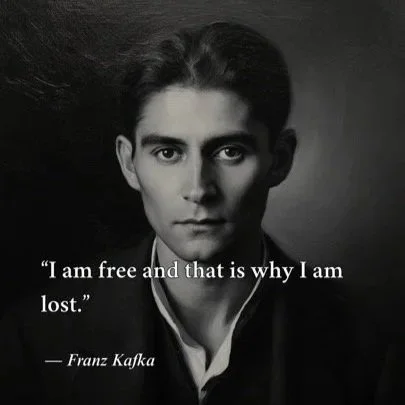
“I am free and that is why I am lost.”
— Franz Kafka
Freedom first looks like failure.
Loss.
Not knowing what to do.
Freedom begins the moment we let go of control and embrace the chaos.
This is why so many people stay stuck. They worship comfort, not transformation. They say they want change, but they want comfort more.
The ego is often like a spoiled child:
“But I don’t want to…”
“You can’t make me…”
“No.”
Too many times I’ve seen clients reach this point and then retreat back into the same pattern they’ve been stuck in, because it feels more comfortable and controllable than taking the leap.
The leap from codependency to interdependency.
From poverty to prosperity of the soul.
From unconscious control, to conscious leadership.
Quite frankly, had they not hired me and BreakBox, they would have kept looping that cycle for years. Maybe their entire lifetime.
But something inside them knew. It was time to transcend the loop.
Why Personal Transformation Often Feels Like Losing Yourself
Break the cycle or be destined to repeat it.
Losing control means the ego has finally stepped back and what comes from that?
What comes next is truth.
When the ego finally steps back, something strange happens.
The identity that used to tell you who you were… goes quiet.
For a moment it feels like failure.
Like loss.
Like you’ve stepped into a fog where the old map no longer works.
But that disorientation isn’t a mistake.
It’s the birthplace of authenticity.
The Ego’s Role in Keeping You Comfortable
The ego’s job was always to create certainty, roles, and strategies for survival. When it loosens its grip, the psyche enters a space the mystics, psychologists, and philosophers have all pointed to.
Not chaos.
Possibility.
This is the phase where:
• Old identities dissolve
• External validation loses its grip
• The nervous system recalibrates
• Intuition gets louder than performance
It feels like being lost because the false map is gone.
But something deeper begins to emerge.
Curiosity.
Truth.
Inner authority.
In Jungian terms, this is when the Self begins to lead instead of the persona.
In Taoist language, it is when you stop forcing the river and begin moving with it.
In BreakBox language, this is the moment the pattern breaks and the real integration begins.
So what comes after the ego steps back?
Not answers.
Awareness.
And awareness eventually becomes direction.
The strange paradox Kafka hinted at is this:
You feel lost precisely because you are finally free from the structures that once told you who you had to be.
And from that freedom, a real life can finally begin. ✨
So what’s next?
This is where real self-mastery begins.
Not fixing behavior.
Not forcing motivation.
Not performing confidence.
Seeing the unconscious patterns that have quietly been running your leadership, relationships, and decisions your entire life.
BreakBox exists for this exact moment.
When someone is ready to stop repeating the same cycles and finally understand the deeper patterns shaping their life.
If you’re in that space right now, where things feel uncertain but something deeper is calling you forward…
Apply for a BreakBox Self-Mastery Assessment.
We’ll identify the unconscious patterns currently shaping your life and map the path to breaking them.
Link below…
With you through your darkness,
Zachary Pike Gandara
𝕻𝖊𝖗 𝖙𝖊𝖓𝖊𝖇𝖗𝖆𝖘 𝖆𝖉 𝖑𝖚𝖒𝖊𝖓 🕯️
Through darkness, into light.

Zachary Pike Gandara is a Self-Mastery Coach and founder of BreakBox Coaching, working at the intersection of Jungian Psychology, Shadow Integration, Somatic Theory, and Transpersonal Alchemy. He works with artists and leaders ready to stop managing their patterns and start dissolving them, so they can live, work, and succeed in their authentic power.
FAQ: Why Do People Feel Lost During Personal Growth?
Why does personal growth make you feel lost?
Personal growth often feels disorienting because it disrupts the identity and psychological patterns that previously gave life structure. When people begin to outgrow old beliefs, roles, and coping strategies, the ego loses its sense of control. This creates a temporary period of uncertainty where the old identity no longer fits, but the new one has not fully formed. Feeling lost during transformation is not failure. It is a natural stage of psychological and emotional evolution.
Is feeling lost a normal stage of transformation?
Yes. Feeling lost is one of the most common stages of deep personal transformation. When someone begins breaking unconscious patterns formed through childhood conditioning, attachment wounds, or survival strategies, their sense of identity temporarily destabilizes. This period of uncertainty allows space for a more authentic self to emerge once the old patterns are fully seen and integrated.
Why do people return to old patterns even when they want change?
People often return to old patterns because the nervous system is wired for familiarity, not necessarily happiness. Even unhealthy behaviors can feel safe simply because they are known. The ego also resists change because it was originally built to protect the individual from perceived threats. Without awareness and integration work, the mind will often recreate familiar dynamics in relationships, leadership, and personal decisions.
What causes repeating emotional or relationship cycles?
Repeating emotional patterns are usually driven by unconscious psychological wounds formed early in life. These often include abandonment, neglect, abuse, or loss. When these wounds are not consciously recognized and integrated, the psyche tends to recreate similar experiences in adulthood in an attempt to resolve them. This is why many people find themselves repeating the same types of relationships, conflicts, or internal struggles throughout their lives.
How do you break unconscious psychological patterns?
Breaking unconscious patterns begins with awareness. Once a pattern is recognized, the next steps involve understanding its emotional origin, regulating the nervous system response attached to it, and consciously choosing new behaviors aligned with one's authentic self. This process is often called shadow integration or pattern recognition work, where hidden motivations and survival strategies become visible and can finally be transformed.
How does BreakBox help people stop repeating the same cycles?
BreakBox Coaching helps people stop repeating destructive patterns by identifying the unconscious psychological programs driving their leadership decisions, relationships, and emotional reactions.
Many of the patterns people struggle with were formed through early attachment wounds, survival strategies, and emotional conditioning that operate beneath conscious awareness. Until these patterns are seen clearly, they quietly shape outcomes again and again.
Through a combination of shadow integration, nervous system regulation, and deep pattern recognition, BreakBox clients learn to identify the unconscious forces influencing their behavior and begin interrupting those cycles.
A unique part of the BreakBox process involves Inner Journeys, guided meditative integration experiences that allow clients to access deeper layers of the psyche. These journeys create a safe internal space where unresolved emotions, memories, and parts of the self can surface and be integrated rather than suppressed.
This process often accelerates transformation because clients are not just talking about their patterns intellectually. They are experiencing and integrating them directly.
As these unconscious patterns become conscious and integrated, clients move from reacting automatically to leading their lives with clarity, stability, and self-awareness.
The result is a shift from unconscious cycles to conscious leadership and self-mastery.